Ask any serious athlete about the surface they train on and you will hear strong opinions. Footing, consistency, and injury risk all trace back to what is under their cleats. In Arizona, where heat and drought punish natural grass, more players, coaches, and homeowners are turning to synthetic turf for sports to get a field that performs the same on the first play as it does on the last. As a family-owned Phoenix company, we build athletic surfaces that hold up to real competition and desert conditions alike.
The case for synthetic turf for sports in Arizona
Natural grass looks great for about a week after it is planted. Then the reality of high-traffic play sets in: worn goal mouths, muddy corners, bare baselines, and uneven patches that turn ankles. Add our climate, scorching summers, minimal rain, and expensive irrigation, and a living field becomes a constant battle. Engineered turf solves that problem by delivering the same playable surface every day of the year.
Consistent footing from edge to edge
Athletes crave predictability. With synthetic turf for sports, the surface density, blade height, and infill stay uniform across the entire field. There are no soft spots or slick patches that change how a ball rolls or how a cleat grips. That consistency lets players cut, sprint, and plant with confidence, which translates directly into better performance and cleaner practice reps.
- Even traction across the whole playing area
- Predictable ball roll, bounce, and speed
- No mud, ruts, or dead patches to work around
A surface that behaves the same everywhere
A worn grass field develops divots, bare patches, and slick spots, and footing gets unpredictable right where the traffic is heaviest. A properly built turf field gives you the same surface in the goalmouth as on the wing, in January and in July. One honest caveat, because you’ll hear the claim from someone: research comparing injury rates on synthetic versus natural surfaces is mixed, and several studies find higher rates of certain lower-limb injuries on synthetic turf. We’re not going to tell you turf prevents injuries. What we stand behind is consistency, drainage, and a surface that doesn’t hide the divots a cleat catches in. If an installer promises you fewer injuries, ask to see the study.
Built for the desert and built to last
Our fields are made for Arizona from the ground up. Quality drainage is the unsung hero here: when a monsoon dumps an inch of rain in twenty minutes, a properly built turf field sheds the water and is ready to play almost immediately, while grass turns into a swamp. That means fewer cancelled practices and games.
Playable year-round
Grass goes dormant, gets overseeded, and needs recovery time after heavy use. Turf never does. Whether it is January or the middle of a Phoenix summer, our sports fields stay green, level, and ready. Teams get more usable hours, and facilities avoid the downtime of reseeding and regrowth. In Arizona that recovery gap is real: overseeding a Bermuda field with winter ryegrass each fall means roping it off for weeks during exactly the season when club and school play ramps up. Turf skips that ritual entirely.
Lower long-term costs
The performance benefits are the headline, but the budget benefits close the deal. Once installed, turf eliminates mowing, fertilizing, reseeding, and, most importantly in Arizona, the enormous water bills that come with keeping grass alive in the desert. A single full-size grass field, roughly 80,000 square feet, can demand more than 4 million gallons of water a year in our climate, about 57 gallons per square foot, and that is water paid for at rising desert rates.
- No irrigation, saving thousands of gallons every month
- No mowing, aeration, or overseeding labor
- A durable surface that stands up to season after season of play
Managing heat on the field
We are always straight with athletes and coaches: turf, like any outdoor surface, warms up in direct Phoenix sun. The difference is that heat is manageable with the right build. We use heat-reducing infills and can recommend lighter fiber tones, shade structures, and a quick misting before play to bring surface temperatures down. Scheduling intense sessions for mornings or evenings during peak summer keeps things comfortable, and hydration stays a priority just as it would on grass or track.
Designing a field around Arizona’s seasons
The smartest athletic installs we do start with the calendar, not just the field dimensions. Arizona’s sports year runs almost inside-out compared to cooler states: our prime outdoor season is October through April, when the weather is glorious and fields see nonstop use, while the deep summer calls for early-morning and evening play. We design with that rhythm in mind. Orienting a field so the low winter sun is not blinding players, positioning shade structures and team benches on the west side where the afternoon heat is worst, and planning a misting line or hose bibs into the build all pay off for years.
For backyard and academy training areas, we often pair the athletic surface with a shaded staging zone so young athletes have somewhere cool to rotate through during summer drills. Because synthetic turf for sports holds its footing whether it is 45 degrees in January or a warm evening in July, a well-planned field genuinely earns its keep in all twelve Arizona months, something a grass field simply cannot promise here.
More than football and soccer
Athletes across many disciplines benefit from a dedicated turf surface. We regularly build fields and specialty areas for training that goes well beyond traditional team sports.
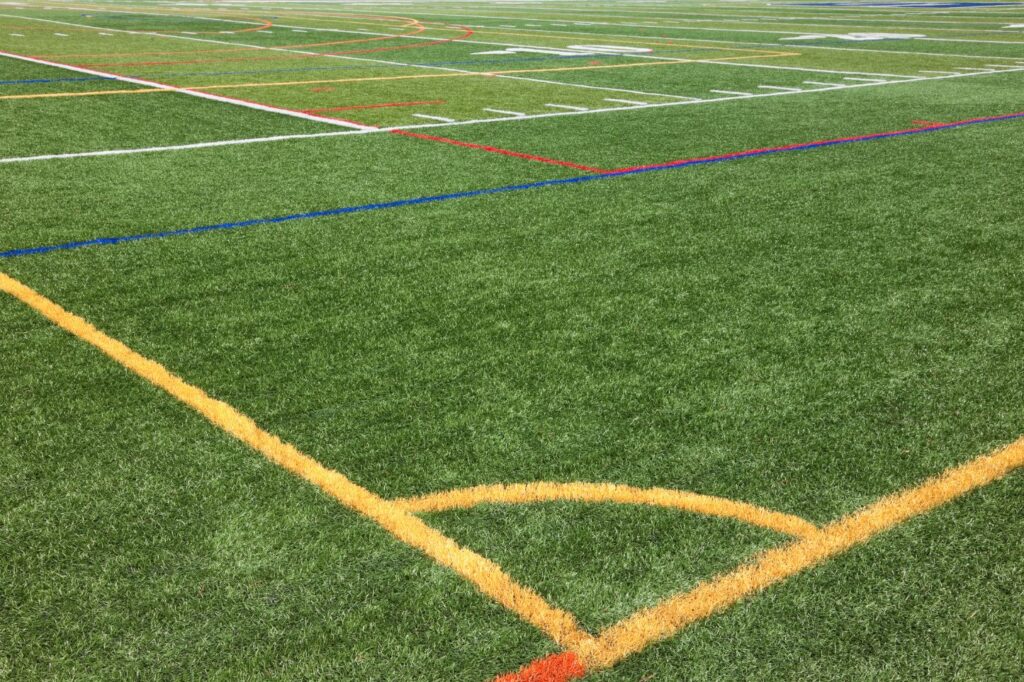
- Soccer, football, lacrosse, and multi-sport fields
- Backyard training and agility areas for young athletes
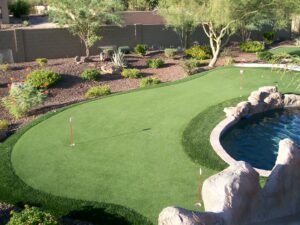
- Golf short-game practice with custom putting greens
Schools and clubs often combine athletic turf with safe, cushioned playground and recreation areas so the whole campus benefits. You can browse finished Arizona installations in our project gallery to see the quality up close.
Before you call us
Is synthetic turf for sports safer than natural grass?
Not a question anyone can answer with a clean yes. The research is mixed, and some studies find higher rates of certain lower-limb injuries on synthetic surfaces. What isn’t in dispute is consistency: a turf field over a proper shock pad and even infill doesn’t develop the ruts, divots, and slick patches a worn grass field shows by mid-season, and it drains instead of turning to mud. That’s the case for it. We’d rather give you that straight than sell you a safety claim we can’t support.
How does turf perform in Arizona monsoon rain?
Very well. A properly engineered field includes a drainage base that sheds heavy rain quickly, so play can resume almost immediately after a storm. Instead of the muddy, unplayable mess that grass becomes, turf stays firm, level, and ready to use.
Does athletic turf get too hot to play on in Phoenix?
Hot enough that it should change your schedule. In peak summer sun a dark synthetic surface can reach 140–150°F. Heat-reducing infill, lighter fibers, and a pre-play rinse all help, and none of them make a field cool in July afternoon sun. A rinse buys you a window, not an afternoon. Plan summer sessions for early and late, and build shade into the project if the field will see midday use.
Give your athletes a surface that performs and protects. Turfscapes of Arizona (ROC #293110) serves Phoenix and the entire state with expert turf installation. Contact us for a free estimate or call our team today at (602) 878-6755 to start planning your field.