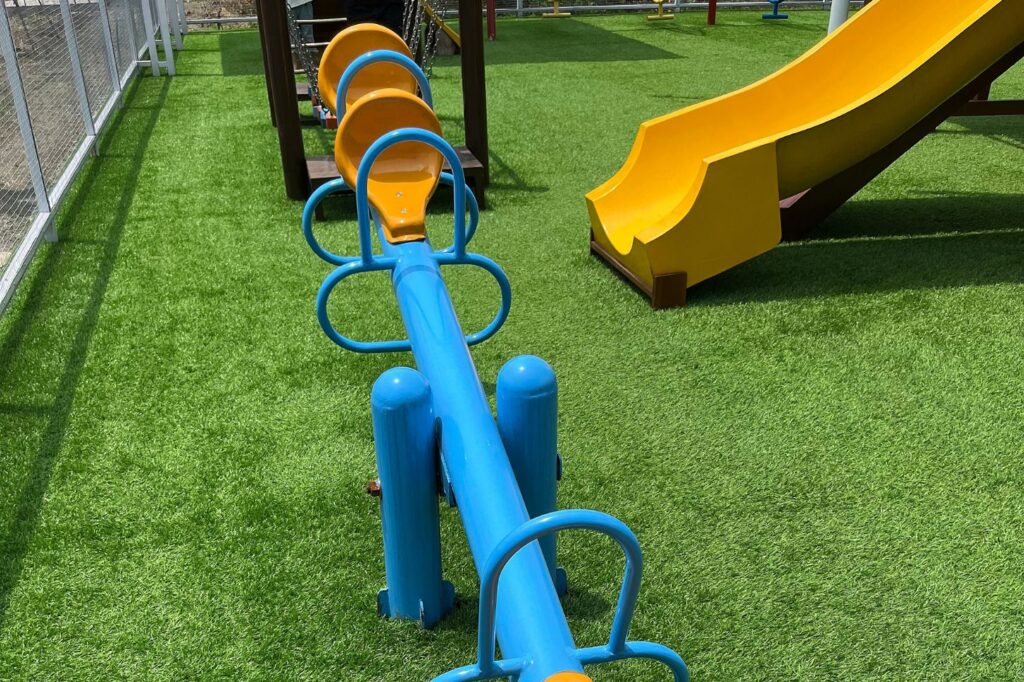
Walk past almost any newly renovated school or community park in the Phoenix area and you will notice something: the old patchy grass and dusty dirt lots are disappearing. In their place is clean, green, cushioned artificial turf for playgrounds that stays usable in every season. As a family-owned company that installs turf for schools and parks across Arizona, we have watched this shift accelerate, and it is easy to understand why.
Desert conditions are tough on traditional playground surfaces. Natural grass struggles in the heat, sand and wood chips scatter and wash away, and bare dirt turns into mud after monsoon storms. Synthetic turf solves all of that at once, which is why administrators and parks departments keep choosing it.
Why artificial turf for playgrounds fits Arizona so well
Our climate is the number one reason. Keeping a natural grass field alive through a Phoenix summer takes enormous amounts of water and constant care, and even then it browns out under heavy foot traffic. Artificial turf for playgrounds stays green and even year-round with none of that upkeep.
The advantages line up perfectly with what schools and parks need:
- Dramatic water savings in a region where every gallon counts.
- No mud, no bare patches, and no dust clouds after play.
- A consistent surface that is usable right after monsoon rain.
- No pesticides or fertilizers around children.
- Lower long-term maintenance costs and labor.
Dust is a bigger deal here than many people realize. The Valley sits in a federally designated dust and particulate zone, and bare dirt play lots are a genuine air-quality and respiratory concern on windy days. A sealed turf surface simply does not kick up that fine, lung-irritating dust, which matters for kids with asthma and for schools working to meet local air standards.
Safety comes first
For any playground, safety is the top priority, and modern turf systems are engineered with that in mind. This is not the thin, hard fake grass of decades past.
Fall protection comes from the pad, not the turf
The turf is the surface. The shock pad underneath is what does the safety work, and pads are rated to a critical fall height under ASTM F1292, the standard a playground inspector checks. The rating you need depends on the tallest piece of equipment on the site, so we measure the equipment first and size the pad to it. We install pads that meet ASTM F1292 and give you the rating in writing before installation. Ask any installer for that number on paper. If they can’t produce it, they’re specifying a lawn, not a playground surface.
A cleaner, healthier surface
Turf drains freely, so puddles and standing water clear quickly after storms. There is no mud tracked indoors, no fertilizer, and no pests hiding in overgrown grass. The infill options we use are chosen with children’s environments in mind.
ADA-friendly access
Unlike wood chips or sand, a turf surface is firm and stable, making it far easier for wheelchairs and mobility devices to cross. That helps inclusive playgrounds welcome every child.
Built to handle heavy use and Arizona heat
School and park surfaces take a beating, hundreds of kids, day after day. The turf we install for these environments is a commercial-grade product built for durability, with strong backing and resilient blades that bounce back instead of matting down.
We also plan for heat. Surface temperature is a real consideration in Arizona, so for high-use play areas we recommend cooler infill options, thoughtful shade placement, and product choices that manage heat better. During design, we walk each site through practical strategies:
- Positioning play areas to take advantage of existing or added shade.
- Selecting infill that helps moderate surface temperature.
- Ensuring proper drainage so the surface dries fast after storms.
- Building a compacted base that stays level under constant traffic.
How turf compares to wood chips and other fill
Most Arizona schools and parks are not choosing turf in a vacuum, they are weighing it against the engineered wood fiber, sand, and rubber mulch they have used for decades. Those loose-fill materials have a hidden cost that shows up fast in our climate. Wood chips break down, blow into the corners of the play area, and need constant raking and topping up to hold the depth their rating depends on. A loose-fill rating under ASTM F1292 assumes a specific installed depth, so the moment wood fiber displaces at a slide exit or under a swing, the surface no longer matches the depth it was rated at. That is exactly why inspectors measure depth at those spots. Sand scatters, tracks indoors, holds heat, and invites pests. Loose fill also washes away during monsoon storms, leaving bare, compacted low spots exactly where kids land hardest.
A bonded turf-and-pad system solves the maintenance treadmill: the cushioning depth stays exactly where it was installed, day after day and season after season, without a crew re-leveling it every few weeks. Over the life of the surface, that consistency is both a safety advantage and a labor savings that grounds crews and facilities budgets feel immediately.
More than just playgrounds
Once a school or park sees how well turf performs, the applications multiply. We install synthetic grass for a wide range of educational and recreational uses through our schools and playgrounds service.
Common projects include:
- Play areas and tot lots with cushioned safety systems.
- General campus green space and courtyards.
- Sports fields and multipurpose activity areas.
- Practice greens and skill areas using our putting greens expertise.
Because we handle everything from residential lawns to large institutional projects, we bring the same durable, water-wise approach to every job, scaled to fit the space and budget.
What the installation process looks like
A great playground surface is built from the ground up. We start by removing the old surface and grading for proper drainage, then build a compacted aggregate base. Next comes the shock pad, followed by the turf itself, seamed and secured, and finally the infill brushed in for stability and cushioning. Done right, the result performs and looks great for many years.
A few things people ask
Is artificial turf for playgrounds safe for young children?
When it’s built correctly, yes. The safety comes from the shock pad under the turf, not the turf itself. We size that pad to the tallest equipment on your site and give you its ASTM F1292 critical fall-height rating in writing before we install. Turf laid over bare ground with no rated pad is not a fall-protection surface, so if a quote doesn’t name a pad and a rating, that’s what you’re being quoted. The turf on top also keeps the area free of mud, pests, and lawn chemicals.
Does playground turf get too hot in Arizona?
Turf does warm in direct sun, but smart design keeps it comfortable. We recommend cooler infill options, strategic shade, and quality products that manage heat. Proper planning makes a big difference in how usable the surface stays through summer.
How long does synthetic playground turf last?
Commercial-grade turf installed over a solid base typically lasts many years, even under constant use. It is built to resist matting and wear, which is exactly why schools and parks see it as a smart long-term investment.
Ready to give your school or park a safer, greener, water-wise play surface? Contact us for a free estimate or call our team at (602) 878-6755. We would be glad to help you plan a playground that Arizona kids will love for years.