If you’ve watched your summer water bill climb while your lawn turns brown anyway, you’ve probably wondered whether artificial turf is worth the upfront investment. It’s a fair question. Quality artificial grass is a real investment, but in a climate like Arizona’s, it’s one that tends to pay you back in water savings, reclaimed weekends, and a yard that stays green through 115-degree afternoons. Here’s an honest look at what drives the cost, how it stacks up against natural grass over time, and when it makes the most sense for your property.
What goes into the cost of artificial turf?
There’s no single sticker price, because the number depends on your specific yard. Any reputable installer will measure your space and give you an itemized, per-square-foot estimate rather than a vague quote. These are the factors that move the price:
- Turf type and quality. Blade material, face weight, pile height, and warranty all affect price. Premium, UV-stabilized turf built for desert heat costs more up front but lasts longer and looks better for years.
- Size of the area. More square footage means more material, base, and labor. This is usually the single biggest driver of the total.
- Site preparation. Removing existing grass, hauling away debris, and grading the surface are essential first steps, and they take time and equipment.
- Base and drainage. A proper crushed-aggregate base is what keeps turf level, firm, and free-draining. Cutting corners here is where cheap installs fail.
- Infill. The material brushed into the turf affects durability, feel, and temperature. Pet-friendly, odor-control, and cooling infills carry different price points.
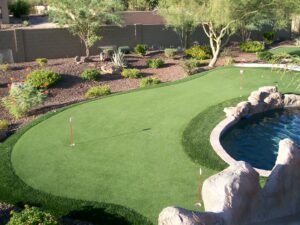
- Complexity and add-ons. Curves, slopes, tree cutouts, borders, or a built-in putting green add labor and materials.
Artificial turf vs. natural grass: the real cost over time
Natural grass looks cheaper on day one, but in Arizona it’s expensive to keep alive. A living lawn in the desert needs constant irrigation, regular mowing, fertilizer, weed and pest control, and reseeding or overseeding to survive the heat. Those costs never stop, they recur every single month, and they climb right alongside water rates.
Artificial turf flips that equation. The cost is front-loaded into the installation, and after that your ongoing expenses drop to almost nothing. Spread across the long lifespan of a quality install, the total cost of ownership often comes in lower than maintaining natural grass, while looking better the whole time. When you compare the two honestly, you’re not comparing a big number to a small one; you’re comparing one upfront number to a small number that repeats for two decades.
How artificial turf pays for itself in Arizona
The savings stack up every year the lawn is in the ground, and the biggest is water. Removing grass saves roughly 57 gallons per square foot a year, a figure cited by Arizona water agencies and the Scottsdale grass-removal rebate program. That is about 57,000 gallons a year on a 1,000-square-foot lawn and closer to 70,000 on a 1,400-square-foot yard. Here is the part most cost estimates miss: Phoenix bills water by the unit and charges more for it in the summer high season, from June through September, which is exactly when a lawn drinks the most. So the water you stop buying comes off at the priciest rate of the year, and heavy use runs the meter up faster the more you pour on. For a typical yard that lands somewhere around $400 to $550 a year, and higher in a hot summer or once your usage climbs the rate schedule. On top of the water you stop paying for mowing, fertilizer, fall overseed, and the gas or lawn-service bills a living lawn runs up.
Add those together and, for a typical yard, the turf recoups its cost in a few years, not decades. How fast depends on your yard’s size and what you spend now. A homeowner paying a weekly mow-and-blow service gets there quickly. A committed do-it-yourselfer takes longer. Either way the savings keep coming for the 15-plus years quality turf lasts.
Turf is not free to keep. You will rinse it and brush the high-traffic spots now and then. But the ongoing cost is a fraction of a living lawn’s, and it does not climb every time the water utility raises its rates.
Who gets the most value from artificial turf?
Turf is a strong investment for almost any Arizona yard, but a few situations make the payback especially fast:
- High water bills or large lawns. The more grass you’re irrigating, the more you save.
- Pet owners. Odor-control, fully-draining pet and dog runs mean no mud, no dead spots, and easy cleanup, a huge quality-of-life upgrade.
- Busy households. If you don’t have time (or desire) for weekend yard work, turf buys that time back.
- Problem areas. Deep shade, hard-to-water strips, and spots where grass simply won’t grow are perfect candidates.
What does artificial turf cost in Phoenix?
Turf is priced by the square foot, and the number moves with a handful of things: the face weight and pile height of the turf you choose, the infill, how much old lawn or concrete has to come out first, and how much base and drainage the site needs. A putting green or a pet area with extra drainage costs more per foot than an open backyard. That is why a flat price quoted sight unseen is a red flag. It usually means the base or the materials get thinned to hit the number.
A useful way to think about it is by project size. A small courtyard or side yard is a quick job with little demo. A standard backyard is the most common project we do. A full front-and-back conversion, or anything with putting greens, pavers, or heavy demo, sits at the top of the range. Where your yard lands depends on the choices above, not on a rate anyone can quote before seeing it.
So instead of a sight-unseen figure, we measure your yard, price the exact turf and prep it needs, and hand you an itemized estimate you can read line by line. The estimate is free and there is no pressure attached to it.
The bottom line
Is artificial turf worth the cost? For most Arizona homeowners, yes, not because it’s cheap, but because it turns a lawn that constantly costs you money into one that saves it. When you factor in water, maintenance, and a long lifespan, quality turf is one of the smartest long-term investments you can make in a desert yard.
What customers usually ask
Is artificial turf cheaper than natural grass?
Up front, no, natural grass costs less to install. Over the years, artificial turf is often cheaper overall once you account for water, mowing, fertilizer, and reseeding, which never stop for a living lawn.
How long does artificial turf last?
A quality, commercial-grade install over a properly prepared base typically carries a 15-year product warranty while staying green and functional year-round.
Does artificial turf add value to my home?
It can. A clean, always-green, low-maintenance yard improves curb appeal and is a selling point for buyers who don’t want the upkeep of natural grass.
Ready to see the numbers for your yard? Request a free, no-pressure estimate or call us at (602) 878-6755 and we’ll give you an honest, itemized quote.