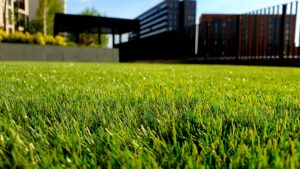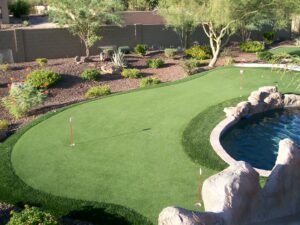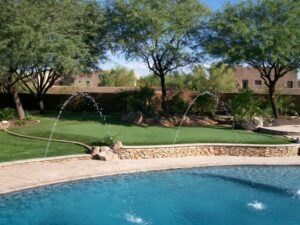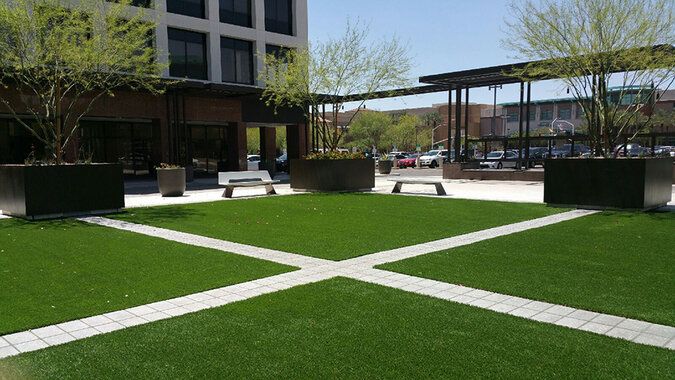
When we walk a commercial site with a property manager, the priorities are always the same: curb appeal, low maintenance, safety, and cost control. That’s exactly where commercial artificial grass earns its keep. Across office parks, retail centers, HOAs, and municipal spaces throughout Phoenix and greater Arizona, we’ve seen turf solve problems that natural landscaping simply can’t in this climate.
Why commercial artificial grass makes sense in Arizona
Commercial properties face a tougher version of every challenge a homeowner deals with. The spaces are larger, the foot traffic is heavier, and the stakes for appearance are higher, a patchy, browning lawn out front tells visitors the whole property isn’t well cared for.
In the desert, keeping natural grass looking presentable across a large commercial footprint is expensive and unreliable. That’s why more Arizona businesses are switching to turf.
Water and cost savings that scale
The bigger the property, the bigger the savings. Commercial landscapes can consume enormous amounts of water keeping natural grass alive through the summer, and that cost only rises each year.
- Eliminate irrigation for turf areas entirely.
- Cut ongoing landscaping labor for mowing and edging.
- Remove recurring costs for fertilizer, seed, and sod.
- Stabilize a landscaping budget that used to swing with the seasons.
For a facilities manager watching every line item, commercial artificial grass turns an unpredictable expense into a fixed, one-time investment.
Always presentable, year-round
First impressions matter in business. Turf looks crisp and green every day of the year, through July heat, monsoon storms, and heavy foot traffic alike. There’s no brown dormancy, no muddy patches, no dead spots by the entrance where everyone walks.
Where commercial artificial grass performs best
We install turf across a wide range of commercial settings, and it adapts to nearly all of them. A few of the most common:
Offices, retail, and common areas
Entryways, courtyards, and greenspaces between buildings stay inviting with zero upkeep. Our artificial turf installations give office parks and shopping centers a polished, professional look that holds up to constant traffic.
Schools, parks, and play areas
Safety is the priority in these spaces, and turf delivers. Our school and playground installations use cushioned, fall-rated systems that stay clean and consistent, with no mud, pesticides, or bare patches for kids to play on.
Sports and recreation facilities
From multi-use fields to practice areas, our sports field turf handles intense, repeated use while staying playable in any weather, a low-maintenance amenity for corporate campuses, resorts, and rec centers alike.
The practical advantages for property managers
Beyond appearance and water savings, commercial artificial grass solves the day-to-day headaches that come with maintaining natural landscaping at scale.
Durability under heavy traffic
Commercial-grade turf is built for wear. High-density fibers and strong backing withstand thousands of footsteps without matting down or wearing thin, which means the greenspace by your busiest entrance stays green.
- No ruts, mud, or worn dirt paths from foot traffic.
- Excellent drainage that clears fast after monsoon rains.
- UV-stable fibers that resist fading in intense Arizona sun.
- A 15-year product warranty and minimal upkeep.
Lower liability and easier maintenance
A consistent, even surface reduces trip hazards compared to uneven natural ground. There’s no irrigation to malfunction, no chemicals to store and apply, and no mowing crews and equipment moving through occupied spaces. Cleanup is as simple as an occasional rinse or blow-off.
Many of our commercial clients pair turf with hardscape pavers to create complete, cohesive outdoor areas, walkways, gathering spaces, and greenery that all require virtually no ongoing maintenance.
HOAs, water policy, and the honest word on rebates
For HOAs and larger commercial owners, the tailwind behind this switch is water policy, not a rebate. As the Colorado River shortage has deepened, Valley cities have pushed hard to cut outdoor water use, and irrigated common-area grass at entries, medians, and clubhouse greenspaces is first on the list.
One point to be straight about, because a lot of sales copy blurs it: the municipal grass-removal rebates in cities like Tempe, Scottsdale, and Phoenix pay for converting grass to low-water desert plants, and most of them specifically exclude artificial turf. So turf itself is not a rebate play. If a board wants the rebate dollars, that means a plant conversion, and we are glad to plan turf and desert planting together so the qualifying areas still capture the incentive.
Where turf earns its place at scale is the running cost. Converting thirsty common areas to turf ends the irrigation on them, cuts the mowing and overseed lines from the maintenance contract, and keeps entries and medians green through a Phoenix August with no brown-out. That is the figure that reshapes a common-area budget year after year, and it does not depend on any rebate.
Common questions
Is commercial artificial grass more expensive than natural landscaping?
There’s a higher upfront investment, but it pays back quickly. Between eliminated irrigation, reduced labor, and no recurring fertilizer or sod costs, most commercial properties recoup the difference within a few years, then keep saving for the life of the turf.
Can commercial artificial grass handle heavy foot traffic?
Yes. We use commercial-grade turf with high-density fibers and reinforced backing specifically engineered for high-traffic areas. It resists matting and wear far better than natural grass, which quickly develops bare, muddy paths in busy spots.
How much maintenance does commercial turf really need?
Very little. There’s no mowing, watering, fertilizing, or reseeding. Routine care is limited to occasional rinsing, brushing high-traffic zones, and clearing debris, a fraction of the time and cost of maintaining a natural commercial landscape.
Ready to upgrade your property with durable, water-wise turf? Contact us for a free estimate or call our team at (602) 878-6755, we’ll help you find the right commercial artificial grass solution for your site.