If you have walked barefoot across a sunny patio in Phoenix in July, you already know the desert has a way of heating up any surface it touches. So it is a fair question before you install synthetic grass: does artificial turf get hot, and if so, can you actually do anything about it? The honest answer is yes on both counts, turf warms in direct sun, and there are proven ways to keep it comfortable.
Heat isn’t the only sun question homeowners ask. We also cover whether artificial grass fades in direct sun.
Does artificial turf get hot in the Arizona sun?
Yes. In full, direct desert sun, artificial turf can get noticeably warm, warmer than the air temperature and warmer than a shaded natural lawn. We will always be straight with you about that. On a 110° afternoon in the Valley, a surface baking in unbroken sun can climb well above the air reading, which surprises people who expect turf to feel like the lawn it replaced. The good news is that turf temperature is very manageable with the right product choices, a little shade, and simple habits. It is not a reason to avoid turf; it is a reason to install it thoughtfully.
Why does synthetic grass heat up?
Living grass cools itself through transpiration, it pulls up water and releases it, creating a natural evaporative-cooling effect. Artificial turf has no such mechanism, so it behaves more like other outdoor surfaces exposed to sun. Two main factors drive the heat:
- Solar absorption: Turf fibers absorb sunlight and radiate that energy back as heat, especially in the intense, long-duration UV exposure the Valley gets.
- No evaporative cooling: Without water moving through it, there is nothing to carry heat away the way a living lawn does.
The infill, the granular material packed between the blades, also plays a role, which is why the type of infill you choose matters for heat. Dark, dense infills like crumb rubber tend to store and hold heat, while lighter mineral-based and coated infills shed it more readily.
When is turf hottest, and when is it not?
Heat is not constant across the day, and knowing the rhythm helps you use your yard comfortably. Here is what we see across Arizona summers:
- Mornings are the sweet spot. Before about 10 a.m., even unshaded turf is usually comfortable underfoot, the perfect window for kids, pets, and coffee on the grass.
- Mid-afternoon is the peak. Surfaces run hottest from roughly 2 to 6 p.m., and areas with harsh western exposure hold that heat longest as the sun drops low and hits them straight on.
- Evenings cool quickly. Once the sun is off the surface, turf sheds heat fast, far faster than concrete or pavers, which keep radiating warmth well after dark.
Monsoon humidity and cloud cover in July and August can take the edge off, too. Planning your play, pet, and lounging zones around these patterns is one of the easiest ways to keep artificial turf comfortable without changing a thing about the product itself.
How to cool artificial turf down
You cannot make turf cold, but you can keep it comfortable. Here are the methods that genuinely work in the desert, roughly in order of impact.
Add shade
Shade is the single most effective factor. Turf that sits under a tree, pergola, shade sail, or the north side of the house runs dramatically cooler than turf in full afternoon sun. If you are planning a play area or a spot the dog will use midday, designing shade into the layout pays off every summer. Even partial afternoon shade over the highest-traffic zone changes how usable the whole yard feels.
Choose UV-stabilized turf and cooling infill
Not all turf is equal. UV-stabilized products are built to resist heat and fading in desert conditions, and pairing them with a cooling infill, one that reflects heat or holds a little moisture, measurably lowers surface temperature next to a standard option like crumb rubber. These are choices best made before installation. For how the infill types actually compare, see our guide to the best cooling turf infill.
Give it a quick rinse
A short spray from the hose drops surface temperature noticeably and fast. The effect is temporary, the desert sun reheats the surface within minutes, but a quick rinse right before the kids or pets go out is a simple, water-light way to take the edge off on the hottest afternoons.
Lighter colors and smart placement
Lighter blade colors reflect a bit more radiation than very dark ones, and thoughtful placement, keeping the largest turf areas out of the harshest western exposure, makes a real difference over the course of a summer.
A simple safety check
Here is an easy field test on a hot day: press your palm flat on the turf for about five seconds. If you cannot hold it there comfortably, the surface is too warm for bare feet or paws, move to shade, rinse it down, or wait for the sun to move. For homes with dogs, a shaded pet and dog run and a cooling infill go a long way toward keeping things paw-friendly.
Cooler by design, not by luck
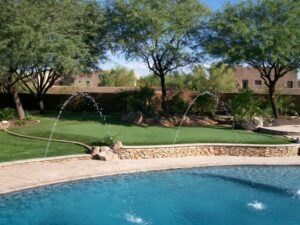
The turf yards that stay comfortable through a Phoenix summer are the ones that planned for heat from the start, quality UV-stabilized turf, the right cooling infill, built-in shade, and easy access to a hose. Combine that with water features or shaded hardscape and you get an outdoor space that is genuinely usable even in the heart of summer.
Before you call us
Does artificial turf get hot enough to burn skin or paws?
In full midday desert sun it can get hot enough to be uncomfortable on bare skin or paws. Use the five-second palm test, add shade, and rinse before use. In shaded areas, turf stays much more comfortable.
Does hosing down artificial turf really cool it?
Yes, a quick rinse noticeably lowers the surface temperature right away. The cooling is short-lived in direct sun, so it works best as a quick step just before you head out onto the turf.
Is there turf that does not get hot at all?
No product stays cold in direct sun, and any company promising that is overselling. What quality UV-stabilized turf and cooling infill do is meaningfully reduce how hot the surface gets compared with standard options.
Want turf that is built for Arizona heat from the ground up? See real projects in our gallery or explore artificial turf, then request a free estimate. We will assess your sun exposure and recommend the right turf, infill, and shade, and give you a free, itemized estimate. Call Turfscapes of Arizona at (602) 878-6755.