It is the question we hear on almost every estimate: “Be honest — will people be able to tell?” Homeowners across the Valley love the idea of a green yard without the water bill, but nobody wants a lawn that screams plastic. So does artificial turf look real once it is installed? In our experience, the answer is a confident yes — when the product is chosen well and installed by people who care about the details. Here is what actually makes modern turf convincing, and where the cheap stuff gives itself away.
Does artificial turf look real up close?
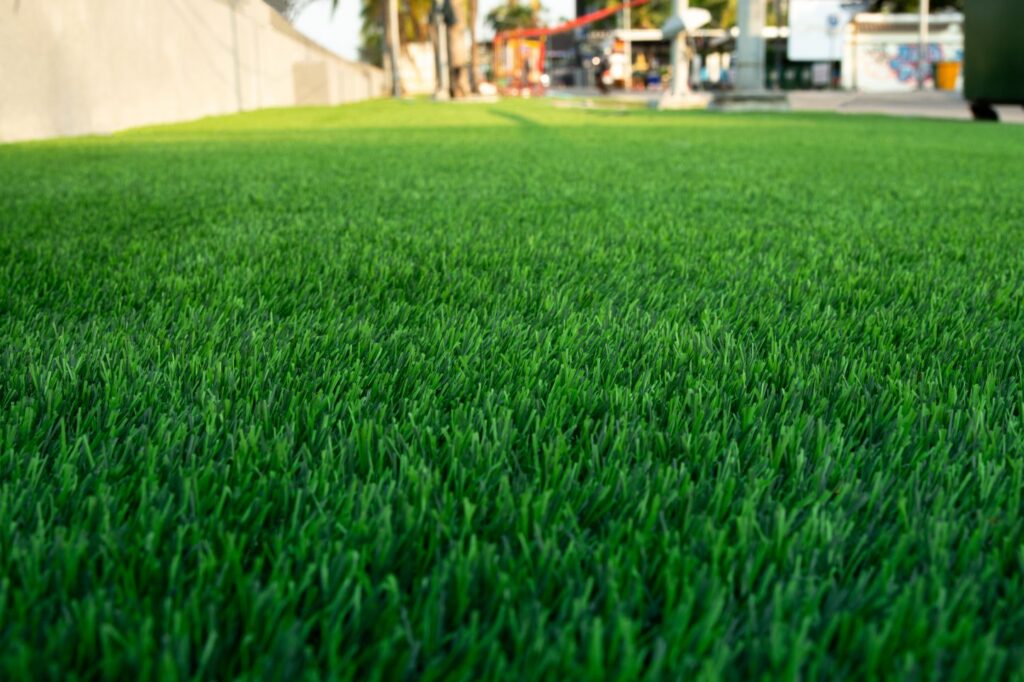
The turf of a decade ago earned its bad reputation — uniform green, stiff blades, an unnatural sheen. Today’s premium products are a different world. The reason people ask does artificial turf look real and then do a double take in our gallery is that manufacturers now engineer turf to mimic the imperfections of a living lawn. Real grass is not one flat color, and good synthetic grass is not either.
- Multi-tone coloring: Two or three shades of green woven together, the way a healthy lawn varies.
- Brown thatch: A layer of tan “dead grass” fibers near the base, just like real turf carries.
- Blade shape: Modern fibers have a spine or “memory” so they stand up and rebound instead of matting flat.
- Matte finish: Quality turf is treated to reduce shine, which is the number one giveaway of cheap product.
What makes turf look real in Arizona
Choosing the right blade and color
Arizona light is intense and unforgiving, so color choice matters more here than in cloudier climates. An overly bright, emerald turf that might pass in Seattle looks obviously fake under a Phoenix sun. We steer homeowners toward more natural olive and field-green tones with visible thatch, which read as a real desert-region lawn. Blade height matters too — a medium pile around an inch and a half looks lush without lying down flat and shiny.
Infill and how turf stands up
Infill is the sand-like material brushed down between the blades, and it does more than most people realize. It weighs the turf down, keeps the backing flat, and — most importantly for realism — it holds each blade upright so the lawn keeps its texture instead of looking pressed and glossy. Skimp on infill and turf mats down into that tell-tale artificial sheen within a season.
Installation details that fool the eye
Honestly, product is only half the story. We have seen premium turf ruined by rushed installation, and modest turf look fantastic because the crew took its time. The details that sell realism include:
- Invisible seams: Blades all running the same direction and seams glued tight so no line shows.
- Crisp, curved edges: Turf tucked cleanly against borders, pavers, and planters — no gaps.
- A smooth, graded base: A properly compacted sub-base so there are no ripples, lumps, or low spots.
- Grain direction: Laying the “lean” of the blades toward the main viewing angle so the yard looks full.
The one detail neighbors notice: how turf meets the desert
Here is a giveaway most articles miss entirely, and it is specific to how we landscape in Arizona. A real lawn rarely stops at a hard, straight plastic line — and neither should yours. The fastest way an otherwise good turf install reads as fake is a visible perforated edge or a bright green rectangle floating in a sea of granite. Because so many Valley yards use decorative rock rather than mulch or garden beds, that transition zone is where the eye goes first.
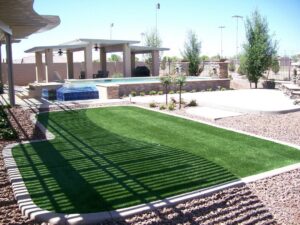
We solve it by bending the turf edge into natural curves, tucking it beneath a mow strip or a course of pavers, and feathering the border rock right up to the blades so there is no daylight between the two. A gentle S-curve along a granite border reads as a designed landscape; a ruler-straight seam reads as a product. We also pay attention to how the lawn meets existing hardscape and irrigation — capping off old sprinkler heads flush, and grading so the turf sits a touch below adjacent pavers so nothing lips up. Get these desert-specific transitions right and the honest answer to does artificial turf look real becomes an easy yes, even from the sidewalk.
Where realistic turf shines
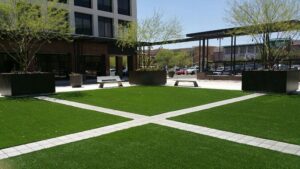
The most natural-looking results often come from blending turf into a full landscape rather than dropping a green rectangle onto dirt. When we pair artificial lawns with plant beds, boulders, and a border of decorative rock and gravel, the turf reads as one part of a designed yard — which is exactly how real grass sits in a landscape. Backyard putting greens are another place realism pays off, since a well-built green with true roll and clean cup lines looks every bit like a course.
Where cheap turf gives itself away
If you have ever spotted fake grass instantly, it was almost certainly a bargain product installed poorly. The usual red flags are a plastic shine in direct sun, a single flat shade of green with no thatch, visible seams or a lifting edge, and blades already matted down. Every one of those is avoidable. Feeling and comparing samples in person — and seeing finished yards — is the fastest way to understand the difference between products that pass and products that do not.
Frequently asked questions
Does artificial turf look real to guests and neighbors?
With a premium multi-tone turf and careful installation, most people cannot tell until they touch it — and even then they are usually surprised. The dead giveaways are shine, matting, and visible seams, all of which come from cheap product or rushed work, not from synthetic grass itself.
Does turf fade or look worse over time in Arizona sun?
Quality turf is UV-stabilized to resist fading for many years under intense Phoenix sun. A light brushing to lift the blades and an occasional rinse keep it looking full and natural. Lower-grade turf without UV protection is what tends to dull and flatten.
Which turf looks the most natural?
Look for multiple green tones, a brown thatch layer, a matte finish, and blades with a spine that stand upright. Natural olive-green colors tend to read best under Arizona light, and the right infill keeps that realistic texture year-round.
Curious whether it would fool you? Browse real Arizona yards in our gallery, then contact us for a free estimate or call (602) 884-8760. We will bring samples so you can judge for yourself.