Every summer, Arizona’s monsoon storms remind us how much power moving water carries. A single afternoon downpour can send sheets of water racing across a yard, carving channels, undercutting patios, and washing expensive soil and gravel straight into the street. If you have ever looked out after a storm and wondered where half your decomposed granite went, you already understand why erosion control landscaping matters so much in the desert.
We are a family-owned team that works with Arizona’s soil and slopes every week, and we have seen what erosion can do to an unprotected property. The good news is that it is preventable. With the right design, your landscape can shrug off even a heavy monsoon.
Why erosion hits Arizona yards so hard
It seems strange that one of the driest places in the country would struggle with water damage, but the desert is uniquely vulnerable. Our soil is often hard and compacted, so instead of soaking in, rain runs off fast. Add sudden, intense monsoon bursts and sloped lots, and you have the perfect recipe for erosion.
The timing is what makes it so punishing. Arizona’s official monsoon season runs June 15 through September 30, and it is not a gentle soaking rain — it is an inch or more falling in twenty or thirty minutes onto ground that has been baked hard and dry for months. Much of the Valley sits on clay or caliche that sheds water almost like pavement, so that sudden volume has nowhere to go but across the surface, picking up speed and soil as it runs. A lot that drains fine in a light spring shower can gully badly in a single August storm.
Left unaddressed, erosion causes real damage:
- Gullies and bare patches that ruin a yard’s appearance.
- Undermined foundations, patios, and pool decks.
- Loss of costly gravel, soil, and plantings.
- Standing water and drainage problems near the home.
Good erosion control landscaping tackles the root cause — the speed and path of water — rather than just cleaning up afterward.
Proven erosion control landscaping solutions
There is no single fix that works for every property. The best results come from combining several techniques suited to your specific slope, soil, and runoff patterns.
Proper grading and drainage
Everything starts with grading. By shaping the land to direct water where you want it to go — away from structures and toward safe outlets — we control runoff before it can do damage. Swales, gentle slopes, and drainage channels are the foundation of effective erosion control landscaping.
Rock, gravel, and rip rap
Stone is one of our most powerful tools against erosion. Larger rip rap on slopes slows water and holds soil in place, while our rock and gravel work armors vulnerable areas across the yard.
- Rip rap and boulders stabilize banks and steep grades.
- Gravel ground cover shields bare soil from splash and runoff.
- Layered stone slows water so it soaks in rather than races off.
Dry creek beds
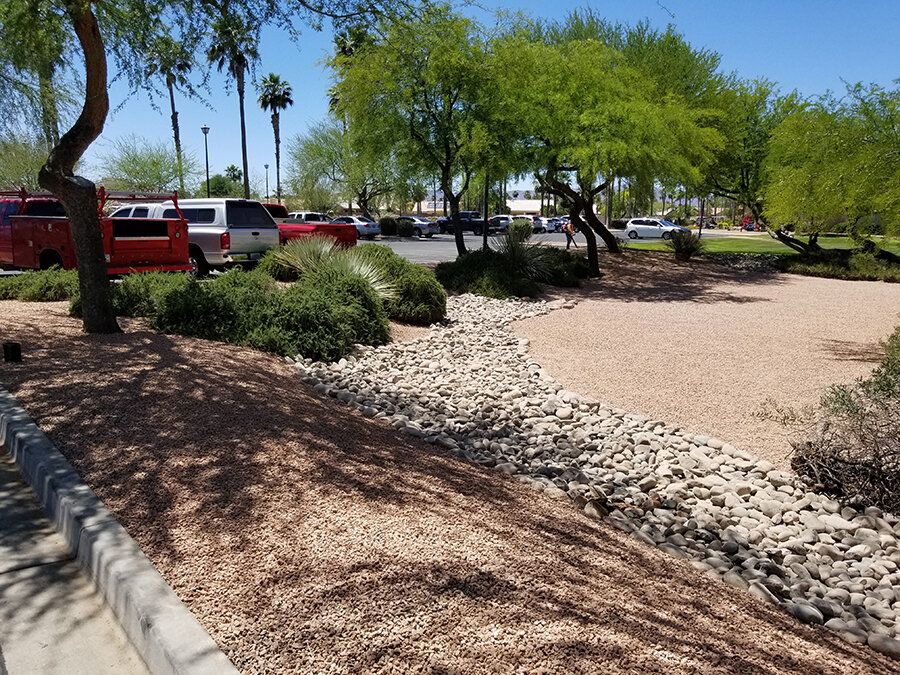
A dry creek bed is both practical and beautiful. Lined with river rock, it gives monsoon water a defined path through your yard, preventing it from cutting its own destructive channel. When storms pass, it stays an attractive design feature.
Ground cover and turf
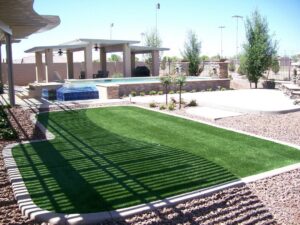
Bare dirt erodes fastest, so covering exposed soil is essential. A stretch of artificial lawn with a properly compacted base creates a stable, root-free surface that will not wash out — and it stays green without watering. Turf is especially effective on gentle slopes where you still want usable, walkable space.
Hardscaping that fights erosion
Structural elements do more than look good; they physically hold your landscape together. Retaining walls, terraced beds, and stabilized patios all interrupt the flow of water down a slope.
Our hardscape and pavers installations are built with drainage in mind, so water moves through and around them instead of pooling or undercutting. Terracing a steep yard into level planting areas is one of the most effective long-term erosion control landscaping strategies we offer, turning a problem slope into a series of usable, stable spaces.
Building for the long term
The key word is long term. Quick fixes like a tarp or a pile of loose rock rarely survive a full monsoon season. We design systems that work together and hold up year after year:
- Correct grading established before anything else goes in.
- Quality base preparation under turf and hardscape.
- Erosion-resistant materials matched to each area’s runoff.
- Defined drainage paths that safely carry storm water away.
Reading the warning signs before a storm hits
Most erosion damage announces itself well before it becomes an emergency, and knowing what to look for lets you act while a repair is still small. After each summer storm, we encourage homeowners to walk the property and note where water has clearly traveled. A few telltale signs mean it is time to call:
- Fan-shaped deposits of gravel or silt spread across a driveway, sidewalk, or into the street — proof that material is leaving your yard.
- Exposed roots, or plants that suddenly sit high on little pedestals of soil while the ground around them has washed lower.
- Small channels or rills forming in the same spot after every rain, which will only deepen with time.
- Pooling water against the foundation, or soil pulling away from the base of the house or a block wall.
- Pavers or stepping stones that have shifted, tilted, or begun to undercut at their edges.
Catching these early is the difference between spreading a few yards of new gravel and rebuilding a slope. If your yard shows any of them, addressing it before the next storm rolls in is almost always the cheaper path.
Frequently asked questions
When is the best time to address erosion?
Before monsoon season is ideal, which in Arizona means spring through early summer. That said, effective erosion control landscaping can be installed year-round, and if you have already noticed damage, the sooner it is corrected the less it will cost to repair.
Can artificial turf really help with erosion?
Yes. When installed over a properly compacted, well-draining base, artificial turf creates a stable surface that resists washout far better than bare soil or struggling grass. It is a great solution for slopes and high-traffic areas that need both stability and a clean look.
Do I need a retaining wall for my slope?
Not always. Many slopes are handled well with grading, rip rap, and ground cover. Retaining walls become valuable on steeper grades or where you want to create level, usable space. We assess each property and recommend only what your yard actually needs.
Worried about how your yard will handle the next big storm? Contact us for a free estimate or call our team at (602) 884-8760. We will design erosion control landscaping that protects your property for years to come.